Short answer: a multiband compressor controls one frequency range without touching the rest. It can tame a boomy low end, for example, without dulling the vocal. In 2026 FabFilter Pro-MB ($199) is still the most flexible all-rounder. Waves C6 ($149 list, often far less on sale) is the pick for very narrow bands. The multiband built into your DAW is good enough for a finished record. If you have no budget, TDR Nova is a free dynamic EQ that solves most of the same problems. We checked every plugin, version and price below on the developers’ own sites on 5 November 2026.
We use multiband compression every week on client mixes and masters, and we’ve used every plugin on this list on real sessions. This is the 2026 update of our list. Since the first version, FabFilter Pro-Q 3 has become Pro-Q 4, Ozone has moved from version 9 to 12, Neutron is on version 5, and several prices have changed. Nothing on the list has been discontinued.
What is multiband compression?
A multiband compressor splits the signal into frequency bands with crossover filters and gives each band its own compressor: threshold, ratio, attack and release. A normal compressor reacts to the whole signal, so a loud kick pulls the vocal and the cymbals down with it. A multiband compressor can react only to the low end and leave everything else alone.
That makes it a targeted tool. It is the right choice when a problem lives in one range: a bass note that jumps out, a vocal that turns harsh on certain words, a low end that swells in the chorus. If a full-band compressor solves the problem, use that instead. Every crossover changes the sound a little.
Best multiband compressor plugins in 2026 at a glance
| Plugin | Best for | Price |
|---|---|---|
| FabFilter Pro-MB 6 bands | Everything, mixing and mastering | $199 |
| Waves C6 6 bands | Very narrow bands, de-essing | $149 list |
| Softube Drawmer 1973 3 bands | Tone and glue on buses | €159 |
| Softube Drawmer S73 3 bands, presets | Fast results | €89 |
| UAD Precision Multiband 5 bands | Mastering on UAD hardware | $99 |
| iZotope Ozone 12 up to 4 bands | Full mastering chain | $219 Standard |
| iZotope Neutron 5 multiband | Mixing single tracks | $299 |
| FabFilter Pro-Q 4 dynamic EQ | Narrow problems, fewer artefacts | $199 |
| McDSP ML4000 multiband + limiter | Loudness with control | $199 Native |
| Your DAW’s built-in 3–4 bands | Learning, and most sessions | Included |
| TDR Nova dynamic EQ | Zero budget | Free |
Regular prices on the developers’ sites on 5 November 2026. Softube shows prices in euros only. Waves, McDSP and Softube were already running Black Friday sales that week, so check before you buy.
The plugins in detail
1. FabFilter Pro-MB

Our most-used multiband compressor. You get up to six bands, and each one is created only where you need it. Each band has threshold, ratio, attack, release, range and knee controls. The crossover phase mode can be Dynamic, Linear or Minimum, and it does upward compression and downward expansion as well as normal compression. Each band can listen to an external sidechain, which is useful for ducking the bass only where the kick hits. Pro-MB is light enough on CPU to use on several tracks in a session.
Version and price: 1.33 (April 2026), $199. Windows, macOS and iPad; VST, VST3, AU, CLAP and AAX.
2. Waves C6

Six bands: four set by crossovers, plus two “floating” bands you can place anywhere and make very narrow. That narrow floating band is the reason we still use C6. It catches one sibilant frequency on a vocal or a single resonance on a bass without touching anything around it. Each band can use internal or external sidechain. Our 2022 list called this the “SideChain Version” and said it had no internal sidechain. Both are out of date: sidechain is now part of the standard C6, internal and external. It has no linear-phase mode. Its character is a little more coloured than Pro-MB.
Price: $149 list. Waves runs sales most of the year, and on 5 November 2026 it was $29.99.
3. Softube Drawmer 1973

A model of Drawmer’s three-band analog compressor. It’s not a surgical tool. It’s for tone and glue on a drum bus, a bus of backing vocals or a whole mix, when you want a sound rather than precise control. It has mid/side processing and a sidechain input.
Price: €159 on Softube’s site, which has a 20-day trial.
- Usually within one working day
- No card, no obligation
- 11,000+ projects behind the answer
4. Softube Drawmer S73

The fast version: a three-band compressor driven by ten mastering “styles”, a Style control, an Air switch and a wet/dry mix. You don’t set bands, attack or release by hand. That is the point: you pick a style, blend it in and move on. We use it to add brightness to vocals and acoustic instruments, and for gentle compression on a mix bus. Our 2022 text described an “Amount” knob, which isn’t on the current version. The wet/dry mix does that job.
Price: €89 on Softube’s site.
5. UAD Precision Multiband

Five bands, each of which can compress, expand or gate. It is clean and controlled, built for mastering. Our earlier text said four bands in one place and five in another: it’s five. One limit to know: it runs only on Universal Audio hardware (an Apollo interface or a UAD accelerator). There is no native UADx version.
Price: $99 (it was $149 in 2022).
6. iZotope Ozone 12

Ozone’s Dynamics module is a capable multiband compressor with up to four bands. It handles downward compression and limiting, upward compression and upward expansion. The reason to buy Ozone is that it sits in a full mastering suite with EQ, imaging, a maximizer and the rest, all in one window. Check which edition you are buying: Dynamics is in Ozone 12 Standard and Advanced, not in Elements. Our 2022 list covered Ozone 9.
Price: Elements $55, Standard $219, Advanced $499.
7. iZotope Neutron 5
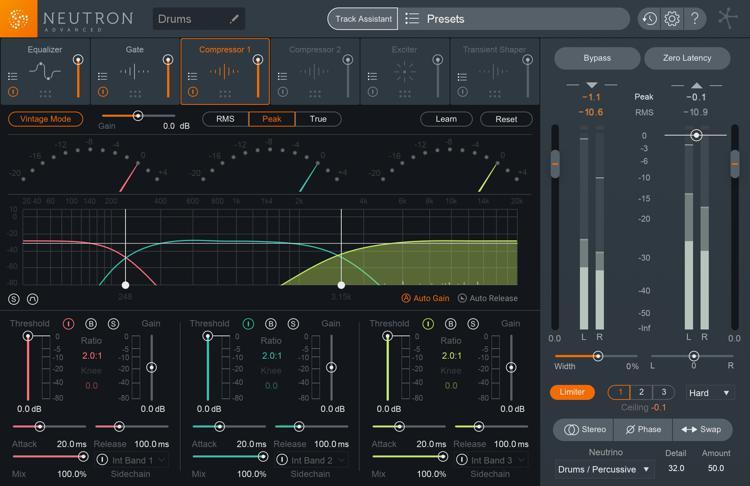
Neutron is iZotope’s mixing suite. Its compressor works in multiband mode, and its Clipper and Density modules are multiband too. The assistant listens to a track and proposes a starting point, which helps when you’re learning. An experienced engineer will usually replace most of what it suggests. Good for single tracks rather than the mix bus.
Price: $299 (it was $399 in 2022).
8. FabFilter Pro-Q 4 (dynamic EQ instead of multiband)

Not a multiband compressor, but it often solves the same problem with fewer side effects. Any band can be made dynamic, so it cuts or boosts only when the signal crosses a threshold. A dynamic EQ band has no crossovers splitting the signal, so it is usually more transparent for one narrow problem, like a harsh word or a boomy note. Pro-Q 4 replaced the Pro-Q 3 pictured here. It adds spectral dynamics and EQ Sketch, with up to 24 bands. Use Pro-MB or C6 instead when you need real compressor behaviour across a band.
Version and price: 4.13 (June 2026), $199 (Pro-Q 3 was $179).
9. McDSP ML4000

A multiband dynamics processor (gate, expander and compressor per band) and a mastering limiter in one plugin. It is clean and powerful, and we use it now and then on drum buses. It is now version 7.
Price: Native $199 (on sale for $149 on 5 November), HD $249.
10. The multiband in your DAW

Every major DAW ships one, and all of them are capable of a released record:
- Pro Tools: Pro Multiband Dynamics (up to 4 bands, sidechain per band)
- Logic Pro: Multipressor (up to 4 bands)
- Cubase: MultibandCompressor (4 bands, sidechain per band)
- Ableton Live: Multiband Dynamics (3 bands, upward and downward)
- REAPER: ReaXcomp (as many bands as you add)
- FL Studio: Fruity Multiband Compressor (3 bands, all editions) and Maximus (Producer Edition and up)
What the paid plugins add is workflow and character: better metering, faster setup, narrower bands, more phase options. They don’t reach results a stock plugin can’t. It’s like a better car: you get to the same place, it’s just more comfortable to drive every day.
Free options
- TDR Nova (Tokyo Dawn Labs, version 2.2.3, free): four dynamic EQ bands plus high- and low-pass filters, and it can work as a multiband compressor. Windows, macOS and Linux. It’s also in our free vocal plugins list. The paid TDR Nova GE adds more bands and upward modes.
- Xfer OTT (version 1.37, free): an extreme upward and downward multiband compressor, popular in electronic production. Treat it as a sound-design effect, not a corrective tool.
How to choose a multiband compressor
- What do you need it for? Fixing one problem calls for a dynamic EQ or a narrow band (Pro-Q 4, C6, TDR Nova). Bus and master control call for clean multiband (Pro-MB, Precision Multiband, Ozone). Tone calls for a coloured one (Drawmer 1973, S73).
- What runs on your system? Precision Multiband needs UAD hardware. Pro-MB, Pro-Q 4 and TDR Nova run almost everywhere.
- Do you need linear phase? On a master, often. On drums, rarely.
- Budget. Your DAW’s multiband plus TDR Nova covers most needs for free.
Our own pairing is one neutral, flexible plugin and one with character: Pro-MB and the Drawmer S73. Waves C6 with the Drawmer 1973 is another good combination. Most of these have trials, so try two before you buy one.
When to use a multiband compressor
- To control a frequency range that jumps out: a bass note, low-end build-up, a harsh vocal range.
- To de-ess or control resonances with a narrow band.
- To duck one range from a sidechain, for example the bass lows only when the kick hits.
- To glue a bus gently, when a full-band compressor pumps.
Related: how to set compressor attack and release times, parallel drum compression and our mixing tips.
Should you use a multiband compressor for mastering?
Only when the mix asks for it. A balanced mix usually needs little more than gentle broadband compression and a limiter. Multiband earns its place when one range really misbehaves and going back to the mix isn’t an option, or when you want a specific effect. If you can fix it in the mix, fix it there. For more on the mastering chain, see the best mastering plugins.
Rather have a release-ready master done by an engineer? Professional mastering here is $50 per song, back in 2–3 days per song, with 6 revision rounds included. If the problem is in the mix, mixing and mastering starts at $133 per song.
Multiband compression FAQ
What is the best multiband compressor plugin in 2026?
For most people, FabFilter Pro-MB ($199): up to six bands, three phase modes, upward and downward processing, and an external sidechain. Waves C6 is the better pick for very narrow bands. TDR Nova is the best free option.
When should I use a multiband compressor instead of a normal one?
When the problem lives in one frequency range and a full-band compressor would drag the whole signal down with it. A bass note that jumps out only in the low mids, or a vocal that gets harsh only on certain words, are the classic cases.
What’s the difference between multiband compression and dynamic EQ?
A multiband compressor splits the signal into bands with crossover filters and compresses each one. A dynamic EQ leaves the signal whole and moves an EQ band in response to level. Dynamic EQ is usually the gentler option, while multiband gives you more control per band, at the cost of the crossovers.
Should I use a multiband compressor when mastering?
Only where the mix asks for it. On a well-balanced mix, a single broadband compressor doing 1–2 dB is usually the better call. Multiband earns its place when one range really misbehaves and going back to the mix isn’t an option.
How many bands do I actually need?
Two or three, most of the time. Every crossover adds phase behaviour of its own, so more bands means more to go wrong. Start with one band on the problem and only add another when you can hear why.
Do multiband compressors cause phase problems?
The crossovers can. Minimum-phase designs shift phase around the crossover points. Linear-phase modes avoid that but add latency and can smear transients before the hit. On a mix bus the linear-phase option is often worth the latency; on drums it often isn’t.
Is the multiband in my DAW good enough?
Yes. Multipressor, ReaXcomp, Multiband Dynamics and the rest can all make a released record. What the paid plugins add is workflow and character, such as better metering, faster setup or a particular colour. They don’t reach a result the stock plugin can’t.
Is there a good free multiband compressor?
TDR Nova from Tokyo Dawn Labs is free on Windows, macOS and Linux. It is a dynamic EQ with four bands that can work as a multiband compressor. Xfer OTT is free too, but it is an extreme effect for sound design rather than a corrective tool.
Stuck on a mix?
Send it as it is — a rough demo or a mix in progress. Max Rayden or Ivan Taiga listens on studio monitors and writes back exactly what is holding the track back, and what to do about it.
- Usually within one working day
- No card, no obligation
- 11,000+ projects behind the answer