
Short answer: the safest cheap pair for a home studio in 2026 is the Audio-Technica AT2020 ($119) as your condenser and the Shure SM58 or SM57 ($109 list) as your dynamic. If you record in an untreated room or a small apartment, start with the dynamic. We re-checked every model below on 5 November 2026: four from our 2022 list are no longer sold new (Rode NT1-A, IK iRig Mic Studio, Blue Spark SL, Nady CYM-2), so each one now has a current replacement.
We mix vocals and instruments recorded in every kind of room, from treated studios to bedrooms. A lot of good records on our desk were cut on the mics below. This is a buyer’s list: what each mic is for, its type, and what it costs now. If you are still deciding between a dynamic and a condenser, or don’t know how much gain your interface needs, read our guide on how to choose a microphone for recording vocals at home first and come back with a shortlist.
How we checked: status and specs come from each manufacturer’s own product page. Prices come from the manufacturer’s US store or from Guitar Center, read on 5 November 2026, in US dollars. Black Friday sales were already running that week, so you will see some sale prices next to the list price. Prices move. Treat them as a guide to the price class, not a quote.
Affordable studio mics in 2026 at a glance
| Mic | Best for | Price |
|---|---|---|
| AT2020 Condenser | First vocal mic, acoustic guitar | $119 |
| Rode NT1 Signature Condenser | Quiet, detailed vocals | $159 |
| AT2035 Condenser | Vocals, amps (pad and filter) | $159 |
| MXL 990 Condenser | Lowest-cost condenser | $89.95 |
| AKG P120 Condenser | Vocals, podcasts | $79.99 sale |
| sE7 (pair) Small condenser | Stereo acoustic, overheads | $249 pair |
| ATM450 Side-address condenser | Hi-hat, acoustic, tight spots | $329 |
| Shure SM58 Dynamic | Vocals in untreated rooms | $109 ($89 sale) |
| Shure SM57 Dynamic | Guitar amps, snare, rock vocals | $109 ($89 sale) |
| Miktek PM10 Dynamic | Snare and toms | $199 |
| Shure SM7B Dynamic | Vocals, rap, screams | $439 ($369 sale) |
| AT4050 Multi-pattern condenser | One mic for many jobs | $769 list |
| Neumann TLM 102 Condenser | Step-up vocal mic | $799 |
| iRig Stream Mic USB USB condenser | Phone, laptop demos | $99.99 |
Prices checked 5 November 2026 at the manufacturer’s US store (Shure, Rode, Miktek, IK Multimedia) or Guitar Center (the rest). “Sale” means a temporary price shown that day.
Which type you need: condenser, dynamic or ribbon
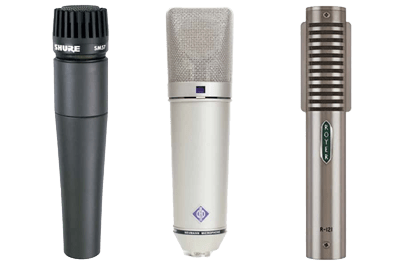
Almost every home studio ends up with two mics: one condenser and one dynamic. Ribbon mics are left out of this list on purpose. Good ones cost more than everything here except the top two, and they are fragile. Most tube mics are out of the budget too. Cheap copies of famous tube mics are a gamble: you rarely know what is inside, and resale value is close to zero.
The bigger point is that at this price level the room matters more than the mic. A modest condenser in a treated corner will beat an expensive one in a bare, reflective bedroom. If your room is untreated and you can’t change that soon, buy the dynamic first.
How a condenser mic works

A condenser (capacitor) capsule is a thin, electrically charged diaphragm sitting close to a fixed backplate. Sound moves the diaphragm, the gap changes, the capacitance changes, and that change becomes the signal. The diaphragm is very light, so condensers respond quickly and pick up fine detail. They need power: almost always 48 V phantom power from your interface.
Large-diaphragm condensers (about 1 inch) are the usual vocal mics. Small-diaphragm “pencil” condensers (about ½ inch) are used for acoustic guitar, overheads and stereo pairs. The catch with any condenser: it hears your room as clearly as it hears you.
How a dynamic mic works
A dynamic mic has a diaphragm attached to a coil inside a magnet. It needs no phantom power, survives drops and handles very loud sources. It is less sensitive than a condenser, which is a disadvantage on quiet sources and an advantage in a noisy or reflective room: you sing close, and the room is quieter in the recording. The trade-off is gain. A low-output dynamic like the SM7B needs much more clean gain from your interface than a condenser does.
Does frequency range matter?
Less than the spec sheet suggests. Most of the condensers here are listed as 20 Hz–20 kHz, and the SM58 is listed as 50 Hz–15 kHz. Yet the SM58 is one of the most-used vocal mics there is. The published curve is measured on-axis in ideal conditions. It says nothing about how the mic picks up sound from the sides, how it handles plosives, or how it sounds on your voice. Use the range as a rough filter and decide by ear.
- Usually within one working day
- No card, no obligation
- 11,000+ projects behind the answer
Best cheap condenser mics
Audio-Technica AT2020

The default first condenser, and still our first suggestion for most people. It’s a cardioid condenser that is simple, sturdy and honest-sounding on vocals and acoustic guitar, with no switches to get wrong. It is also a proven record-maker: Finneas told Sound On Sound that Billie Eilish’s vocals for “Ocean Eyes” were recorded with an AT2020.
Specs: cardioid condenser, 20 Hz–20 kHz, max SPL 144 dB, 48 V phantom. Price: $119.
Rode NT1 Signature (replaces the NT1-A)
The NT1-A from our 2022 list is gone: its page on Rode’s site no longer exists, and US retailers list it as no longer available. The current low-noise large-diaphragm option from Rode is the NT1 Signature. If you also want a USB connection, the NT1 5th Generation ($249) has both XLR and USB outputs.
Specs (NT1 Signature): cardioid condenser, 20 Hz–20 kHz, max SPL 142 dB, 48 V phantom. Price: $159.
Audio-Technica AT2035 (replaces the Blue Spark SL)
The Blue Spark SL is no longer sold new since the Blue brand moved under Logitech G. You will only find it used. The AT2035 fills the same slot: a large-diaphragm cardioid condenser with an 80 Hz high-pass filter and a 10 dB pad. Those two switches help with a boomy room, a loud singer or a guitar amp.
Specs: cardioid condenser, max SPL 148 dB (158 dB with pad), phantom 11–52 V. Price: $159.
MXL 990

The cheapest condenser on the list and a common first mic for vocals, voice-over and podcasts. It has a slightly forward top end, which some voices like and others don’t. It is a FET condenser with a 6-micron capsule.
Specs: cardioid condenser, 20 Hz–20 kHz, max SPL 130 dB, 48 V phantom. Price: $89.95. In 2022 we listed $159.99, so this is one of the few mics that got cheaper.
AKG P120

A budget large-diaphragm condenser for vocals, acoustic guitar and spoken word. It has a 20 dB pad and a 300 Hz bass-cut switch. AKG still lists it on its global site, but it no longer appears in AKG’s US store, so buy it from a retailer while stock lasts.
Specs: cardioid condenser, 20 Hz–20 kHz, needs phantom power (44–52 V). Price: $79.99 on sale (normally $99).
sE Electronics sE7 (also replaces the Nady CYM-2)

A small-diaphragm pencil condenser that works best as a matched pair: stereo acoustic guitar, piano, drum overheads. It has a 20 dB pad and an 80 Hz low-cut switch. In 2022 we also listed the Nady CYM-2 pair at about $100. Nady still lists it, but it was out of stock when we checked, so the sE7 pair is now our stereo pick even though it costs more.
Specs: cardioid small-diaphragm condenser, max SPL 136 dB (156 dB with pad), 48 V phantom. Price: $249 for a pair.
Audio-Technica ATM450

An unusual one: a condenser in a slim stick body that you address from the side, not the end. That makes it easy to fit over a hi-hat, between toms or close to an acoustic guitar without the mic getting in the player’s way.
Specs: cardioid condenser, side-address, max SPL 152 dB, phantom 11–52 V. Price: $329 (it was $279 in 2022).
Best cheap dynamic mics
Shure SM58

The most common vocal mic in the world, and a better home vocal mic than its price suggests. Its tight pickup and built-in pop protection make it forgiving in an untreated room. Sing close, keep the room quiet, and an SM58 vocal will mix well.
Specs: cardioid dynamic, 50 Hz–15 kHz, sensitivity −56 dBV/Pa, no phantom needed. Shure doesn’t publish a maximum SPL for it. Our 2022 list said “94 dB”, which was wrong: 94 dB SPL is only the reference level used to measure sensitivity. Price: $109 list, $89 on sale on 5 November.
Shure SM57

The standard mic for guitar amps and snare, and a real option for rock vocals. Reverb’s history of the SM57 cites Brandon Flowers recording the vocals on The Killers’ Hot Fuss with one. It also quotes engineer Jim Scott saying Anthony Kiedis used one for lead vocals on Californication.
Specs: cardioid dynamic, 40 Hz–15 kHz, sensitivity −56 dBV/Pa, no phantom needed. No max SPL is published. Price: $109 list, $89 on sale.
Shure SM7B

The dynamic vocal mic for rap, rock, broadcast, and anywhere the room is a problem. It is also the mic we recommend for screamed vocals. Its bass roll-off and presence-boost switches cover most voices. Plan for its very low output (−59 dBV/Pa). That’s about 22 dB less signal than an AT2020, so many interfaces need an inline booster to get a clean level. Shure’s SM7dB has that booster built in ($549 list, $459 on sale).
Specs: cardioid dynamic, 50 Hz–20 kHz, no phantom needed for the SM7B itself. Price: $439 list, $369 on sale.
Miktek PM10

A supercardioid dynamic tuned for snare and toms. Buy it if you record a real drum kit at home and already own an SM57 for the snare top. It’s not a vocal mic.
Specs: supercardioid dynamic, no phantom needed. Price: $199 at Miktek’s own store.
Worth stretching for
Audio-Technica AT4050

The most flexible mic here: cardioid, omni and figure-of-eight in one body. That means one mic covers vocals, a room mic in omni, and, paired with a second mic, mid-side stereo. Only worth it if you will actually use the extra patterns.
Specs: multi-pattern condenser, max SPL 149 dB (159 dB with 10 dB pad), 48 V phantom. Price: $769 list, $576.75 on sale at Guitar Center on 5 November.
Neumann TLM 102

A compact Neumann large-diaphragm condenser and a clear step up for vocals. It only pays off once the room is treated. In a bare room it will capture the reflections in more detail too.
Specs: cardioid condenser, 20 Hz–20 kHz, max SPL 144 dB, 48 V phantom. Price: $799 (it was $729 in 2022).
USB microphones
A USB mic has the preamp and converter built in. That’s convenient for phone and laptop demos, but nothing can be upgraded separately later. An XLR mic plus a basic interface costs a little more and grows with you. If you want USB anyway:
- IK Multimedia iRig Stream Mic USB: cardioid condenser with USB-C, $99.99 at IK’s store. It replaces the iRig Mic Studio from our 2022 list, whose product page now redirects to this model.
- Shure MV7+: a dynamic with both USB and XLR outputs, so it stays useful after you buy an interface. $299 list, $255 on sale at Shure.
No longer sold new: what happened to the 2022 picks
You will still see these on the used market, and they still work. We dropped them because you can’t buy them new any more.
Rode NT1-A

Replaced in Rode’s range by the NT1 Signature and NT1 5th Generation (above). A used NT1-A in good condition is still a decent vocal mic.
IK Multimedia iRig Mic Studio

IK’s product page now redirects to the iRig Stream Mic USB.
Blue Spark SL

Not available new from Logitech G. Used only. Our replacement in the same role is the AT2035.
Nady CYM-2

Still listed by Nady at $109.99 but out of stock on 5 November 2026. For a stereo pair, see the sE7.
Best mic for a small apartment
If you record in a small, untreated room with neighbours on the other side of the wall, get a dynamic: an SM58 to start, an SM7B if the budget allows. Sing 5–10 cm from the grille and turn the gain up rather than backing off. The closer you are, the louder you are compared with the room and the street. A condenser in the same room will capture flutter echo off bare walls, and that is very hard to remove in the mix. Our DIY vocal booth guide shows how to deaden a corner cheaply if you want to move to a condenser later.
Before you record
Whichever mic you choose, a pop filter and a shock mount cost little and save takes. Record with peaks around −10 to −6 dBFS so a louder line doesn’t clip. Record a few seconds of silence in the room, too: if you can hear a fridge or traffic in that silence, fix it before the take, not after. Our guide to recording your song at high quality goes through the rest of the chain.
Recorded the takes and want them to sit like a release? Our engineers mix your song from $113 (online mixing), or mix and master it from $133 per song, in 2–3 days per song with 6 revision rounds included. Not sure whether the problem is the mic or the room? Send the rough mix to our free track review.
Affordable studio mics FAQ
What’s the best cheap microphone for a home studio?
For most people, the Audio-Technica AT2020 ($119 on 5 November 2026) as a first condenser. If your room is untreated or noisy, start with a Shure SM58 or SM57 ($109 list) instead and add a condenser once the room is sorted.
Is the Rode NT1-A still available?
Not new. Rode has removed its product page, and US retailers list it as no longer available. The current equivalents are the Rode NT1 Signature ($159) and the NT1 5th Generation ($249, with XLR and USB).
Condenser or dynamic for vocals at home?
Condenser in a treated space, dynamic in an untreated one. A dynamic picks up less of the room because you sing closer and it is less sensitive. In a bare room, that matters more than the extra detail a condenser gives you.
Is the Shure SM7B worth it for a beginner?
Only if your interface can drive it. The SM7B’s output is about 22 dB lower than an AT2020’s, so many entry-level interfaces need an inline booster for a clean level. Budget for that, or look at the SM7dB, which has the booster built in.
Do I need phantom power?
For every condenser on this list, yes. Almost every audio interface provides 48 V phantom power on its mic inputs. Dynamic mics like the SM58, SM57 and SM7B don’t need it, and phantom power doesn’t harm them.
Is a USB mic good enough to release music?
For demos and writing, yes, and a well-performed take on a USB mic can make a release. The limit is that the preamp and converter are built in, so nothing upgrades separately. An XLR mic and a basic interface cost a little more and last longer.
Does an expensive mic make my vocals sound professional?
Not on its own. At home the room and the performance are the limits long before the microphone is. A treated corner and a good take on an AT2020 will mix better than a reflective room on a mic that costs ten times as much.
How current are these prices?
We read every price on 5 November 2026 at the manufacturer’s US store or Guitar Center. Sales come and go, especially around Black Friday, so check the retailer before you buy. The type and the role of each mic don’t change with the price.
Not sure what is off with your vocal?
Send the song as it is — rough is fine. Max Rayden or Ivan Taiga listens on studio monitors and writes back exactly what is holding the track back, and what to do about it.
- Usually within one working day
- No card, no obligation
- 11,000+ projects behind the answer
Order Complete Mixing and Mastering What it includes All prices